

Kindergarten, Reimagined: Choosing Montessori for a Lifetime of Learning
Choosing an Education with the Long View in Mind
Somewhere between five and six, childhood shifts again.
Not abruptly, but subtly.
Parents feel it. Teachers see it. A child who once moved comfortably within familiar routines suddenly asks bigger questions. Their emotions feel stronger. Their sense of fairness sharper. They are no longer content to simply follow the world as it is. They want to understand why it works the way it does.
If you are choosing a Kindergarten right now, this moment matters.
Because the upcoming year is not just another step forward.
It is a turning point.
Choosing Montessori for Kindergarten is not only about building strong foundations in literacy, math, science and language. It is about shaping how your child approaches learning itself - with confidence, curiosity, and joy that can last a lifetime.
A Child at the Threshold
In the early years of life, children are busy building themselves from the inside out. They learn to walk, to speak, to dress, to care for their world. Repetition brings comfort. Order brings security. Meaning comes from doing something carefully and well.
As children near six, that inward work begins to turn outward.
The child who once delighted in quiet repetition may now be talkative, imaginative, and socially aware. Questions appear everywhere. Why? How? What if? They begin to notice rules, fairness, and how their actions affect others. Their thinking stretches beyond what is immediately in front of them.
Maria Montessori described this as a kind of rebirth: the child standing at the edge of two stages of development. The absorbent mind of early childhood is completing its work, and a new kind of thinking is beginning to take shape.
Why Kindergarten Feels Different
In Montessori, the Kindergarten year is often called the Leadership Year.
It is the final year of the three-year 3–6 cycle, and it plays a quiet but powerful role in a child’s development. At five and six, children are ready for responsibility, purpose, and meaningful challenge. In the Montessori classroom, Kindergarteners are the oldest members of the community. They know the materials. They understand the rhythm of the day. And because of that familiarity, they begin to move with confidence.
They help younger children, demonstrate lessons, and take pride in contributing to their classroom.
This leadership is not assigned or rehearsed. It grows naturally when children are trusted with real responsibility. Through this experience, children begin to see themselves as capable, thoughtful members of a community.
Learning That Settles In
Academically, the Kindergarten year is a time of deepening.
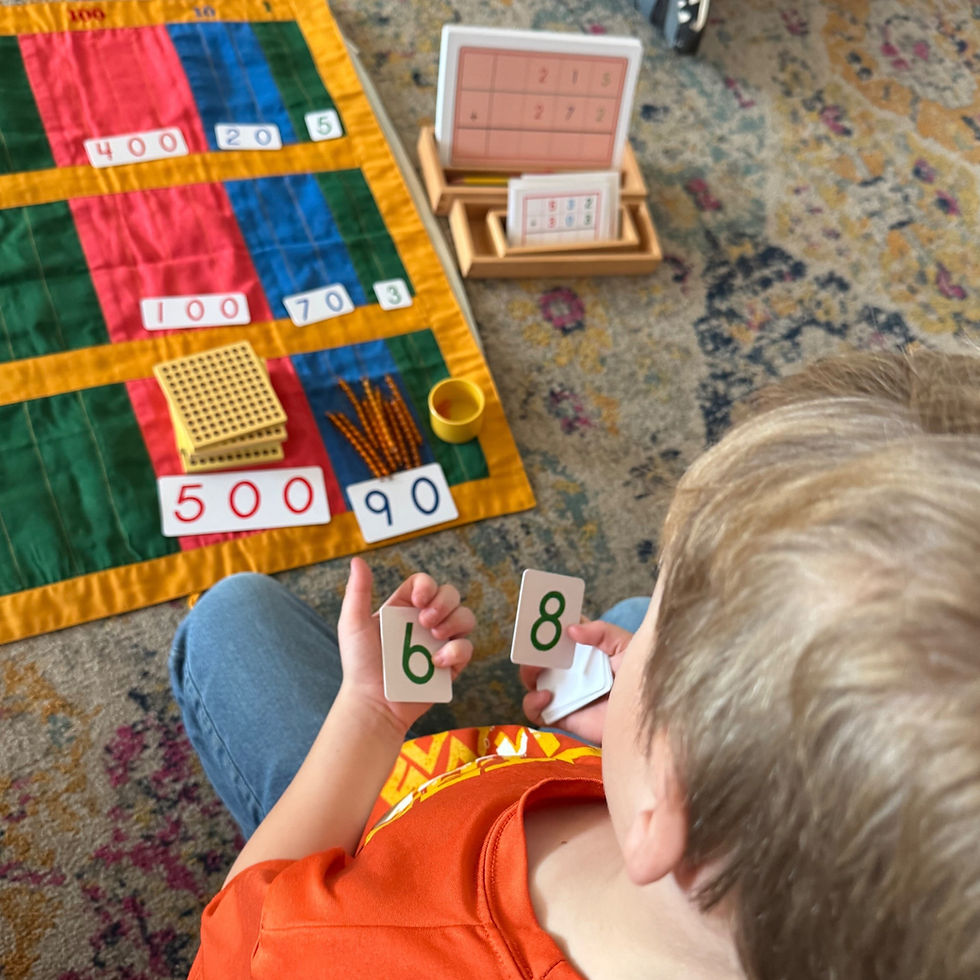
Early experiences with reading, writing, and mathematics begin to settle into true understanding. Children work with numbers they can see and feel. They write not because they are told to, but because they have something to say. They stay with work longer, returning to it over days as ideas take shape.
This kind of learning does not rush toward abstraction. It prepares for it. Through hands-on materials, children form mental images that support future reasoning. What they understand now becomes the foundation they will rely on later, not just in school, but in how they approach new challenges.
More importantly, children develop habits that last: concentration, persistence, curiosity, and confidence in their own thinking.

Learning That Comes From Within
At ages five and six, learning is still rooted in experience.
The hands remain deeply connected to the mind, guiding understanding through movement and purposeful work. Montessori understood this clearly.
“The child has a mind able to absorb knowledge. He has the power to teach himself.”
Learning at this stage does not come from memorizing information or completing worksheets. It comes from engaging fully with the environment - touching, building, testing, and refining ideas.
“Education is a natural process carried out by the child and is not acquired by listening to words but by experiences in the environment.”
When learning feels meaningful, imagination awakens. Curiosity deepens. Joy becomes visible. This is the heart of Montessori Kindergarten - learning that belongs to the child.
Growing into the Social World
Around this age, children begin to see themselves more clearly as part of a group. Friendships matter. Fairness matters. Rules are questioned and negotiated. Children begin organizing their own games and resolving conflicts together.
In Montessori classrooms, guides support this growth through conversation, collaboration, and gentle guidance. Children learn how to listen, how to express themselves, and how to work for the good of the group.
These social and emotional skills are not extras. They are an essential part of preparing children for elementary school and for life beyond it.
A Place to Continue Well... or to Begin
For families already in Montessori, the Kindergarten year allows children to complete the First Plane of Development with confidence, consolidating learning and stepping fully into leadership.
For families new to Montessori, Kindergarten can also be a beautiful place to begin. At five and six, children are developmentally ready for independence, responsibility, and purposeful work. Montessori classrooms are designed to welcome them, with individualized lessons, self-correcting materials, and a culture that supports belonging.
What matters most is readiness and curiosity, not prior experience.
Kindergarten at Mi Escuela Montessori
At Mi Escuela Montessori, Kindergarten students experience hands-on literacy, concrete mathematics that builds real understanding, and Spanish–English immersion woven naturally into daily life. Children work within long, uninterrupted work cycles, move freely, and take on meaningful roles within their classroom community.
They are trusted.
And they rise to that trust.

Choosing with the Long View in Mind
Choosing Montessori for Kindergarten is not only about this year. It is about how your child learns to approach the world, with confidence, curiosity, and a belief in their own ability to think deeply and learn well. The habits formed now do not fade when Kindergarten ends. They become part of how your child meets every new challenge that follows.
If you are choosing a Kindergarten right now, this decision matters.
Montessori Kindergarten is not simply a place to start school.
It is a place where a lifetime of learning takes root.
“Our aim is not merely to make the child understand, and still less to force him to memorize, but so to touch his imagination as to enthuse him to his innermost core.”


Comments